
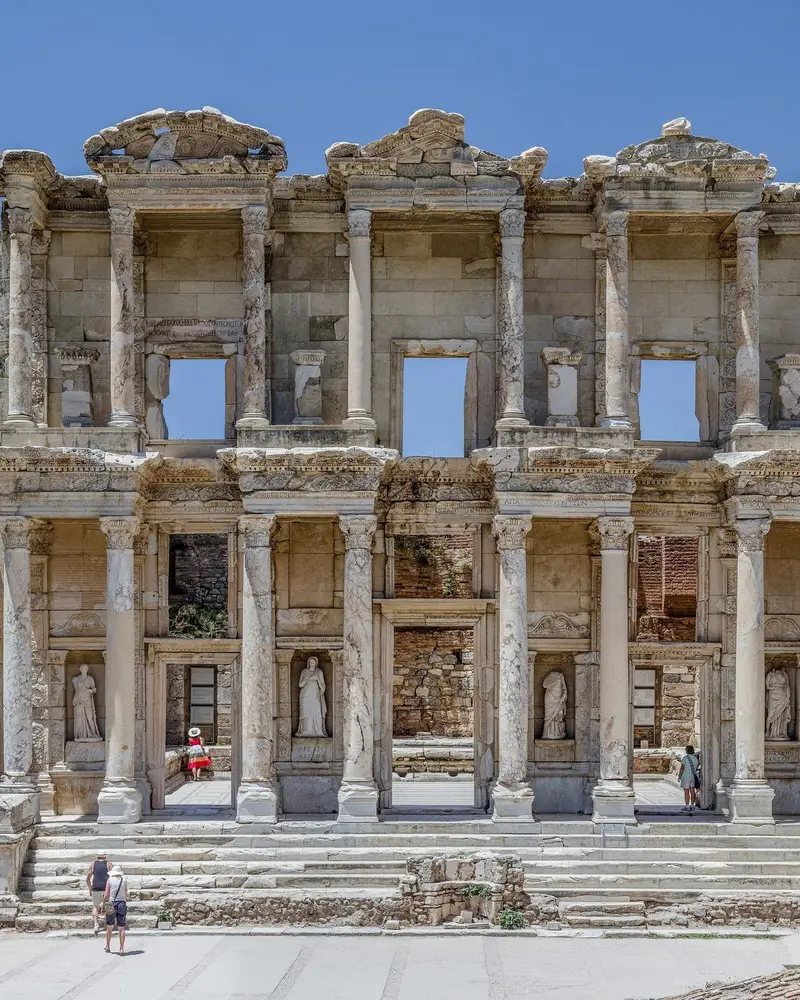
Photo: “Ephesus Celsus Library Façade”, Benh LIEU SONG · CC BY-SA 3.0 · Wikimedia Commons. Cropped and resized for the web.

TÜRKIYE · 10TH CENTURY BC
Ephesus
Ephesos
Ephesus moved several times, following the shoreline west as silt filled the Kaystros estuary. Its remains, among them the Library of Celsus, the Great Theatre, the terrace houses and the site of the Temple of Artemis, make it one of the finest Roman harbour cities.
- Original name
- Ephesos
- Country
- Türkiye
- Period
- 10th century BC
- Civilisation
- Greek
- UNESCO
- On the World Heritage List
- Location
- 37.9414° N, 27.3406° E Open in OpenStreetMap Open in Apple Maps
If Antigone is installed, this button opens the city straight in the app.
Areas of the site
-
Ancient City of Ephesus
The main site of the city that became capital of the Roman province of Asia, with the Library of Celsus, the Great Theatre and agoras.
-
Terrace Houses
Built on terraces on Bülbüldağı in the 1st century AD, these houses of wealthy families are known for their mosaics and wall paintings.
-
Temple of Artemis (Artemision)
Of this temple, counted among the Seven Wonders of the Ancient World, only the foundations and a single re-erected column remain.
-
Ayasuluk Hill and the Basilica of St John
One of the earliest settled spots of Ephesus, the hill carries the basilica built over the tomb of St John and a medieval castle.
-
House of the Virgin Mary
This small domed, cross-shaped chapel on Bülbüldağı has long been a major place of Christian pilgrimage.
A QUESTION FROM THE ROAD
What is the famous library in Ephesus called?
The answer, and all of the city’s lessons, are in the app.